
Lealman Crime, By the Numbers: Part 2
Residential-burglary and auto-theft charges in the sheriff's Lealman study area fell sharply across three reporting periods, a substantial improvement in two categories that affect residents' homes and transportation. But a separate vehicle-theft category rose, and the figures do not explain what drove either change.
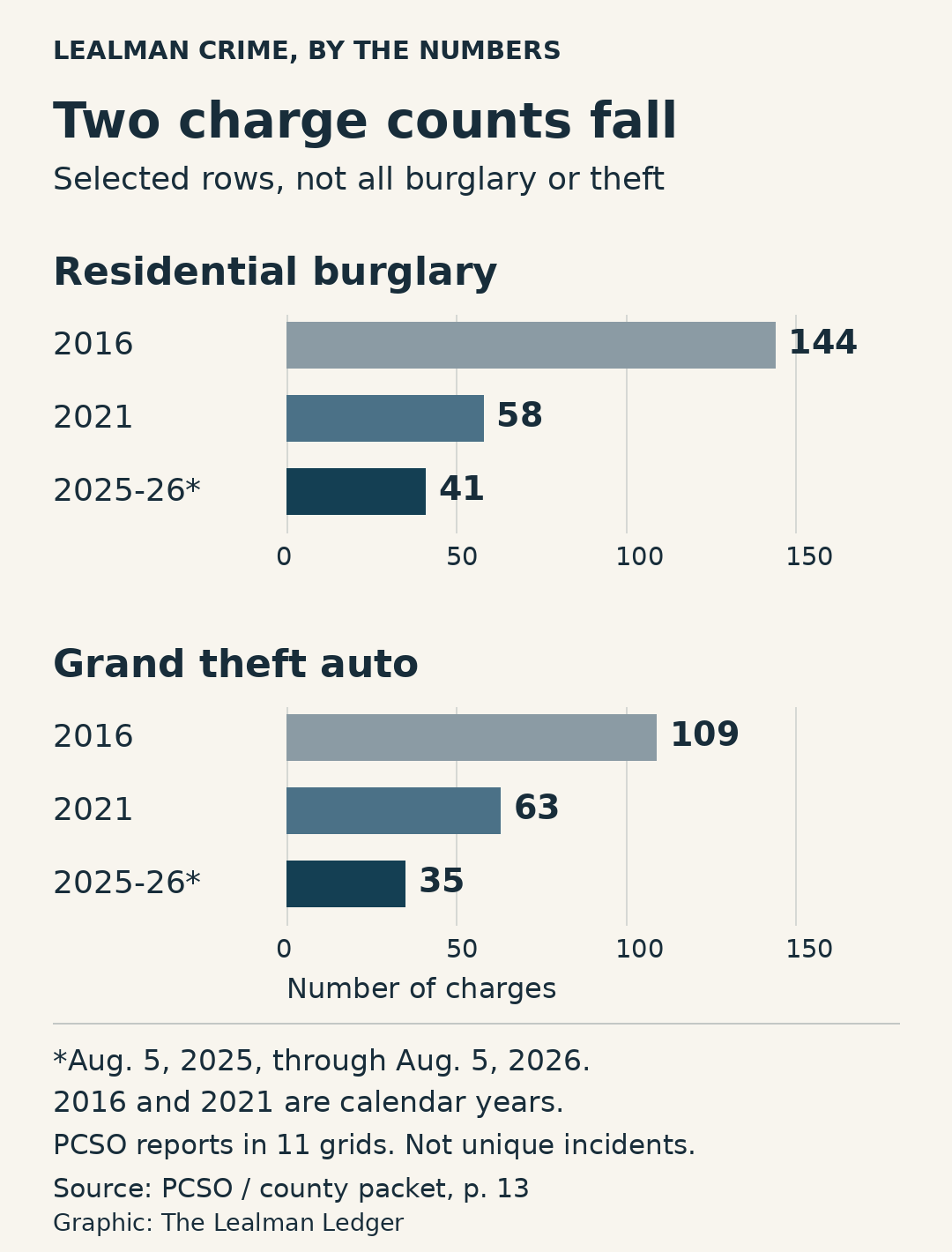
The residential-burglary row in the county agenda packet's charge table drops from 144 in calendar 2016 to 58 in calendar 2021 and 41 in the latest period, Aug. 5, 2025, through Aug. 5, 2026. That is 103 fewer charges than in 2016, a decrease of about 72%.
The grand-theft-auto row falls from 109 to 63 to 35 over the same periods. Its latest count is 74 lower than in 2016, a decline of about 68%.
Both rows also declined after the 2021 snapshot. Residential burglary fell by 17 charges, about 29%. Grand theft auto fell by 28, about 44%. Those are changes between the specified reporting periods, not annual rates of decline.
The two rows do not capture every burglary or vehicle-theft charge in the report. Armed residential burglary is listed separately, as are residential burglary involving the surrounding grounds and several other burglary classifications. Those rows should not disappear behind a broad claim that all home burglaries fell 72%.
Other burglary rows generally point in the same direction. The commercial-burglary row falls from 20 to 11 to seven, while burglary of a conveyance falls from 157 to 112 to 67. Burglary of a conveyance is a separate charge category from stealing an automobile; the two rows should not be treated as interchangeable measures of car theft.
There are exceptions. The structure-burglary row rises from seven in 2021 to eight in the latest period, although it remains below the 2016 count of 13. More substantially, the row labeled “GRAND THEFT OTHER VEHICLE TYPES” rises from nine in 2021 to 22, an increase of 13 charges, or about 144%. It recorded zero in 2016.
The packet does not identify which vehicle types account for those 22 charges or explain whether classifications changed. It therefore cannot tell residents whether that increase reflects a new theft problem, a coding change or some combination. The table marks the percentage change with asterisks because its stated rule omits changes of 100% or more in magnitude.
These are charges attached to Pinellas County Sheriff's Office offense reports in 11 geographic grids, not a count of unique break-ins, stolen cars, victims or convictions. Reports from other agencies are excluded. One offense report can contribute multiple applicable charges. The totals also are not adjusted for population.
As Part 1 explained, the report provides three snapshots rather than an annual series. Calendar-year counts for 2016 and 2021 are compared with a full-year window crossing 2025 and 2026. Those limits do not erase the declines, but they prevent the chart from establishing a continuous downward trend or each resident's risk.
There is a broader national backdrop. The FBI's 2025 national summary, released in August 2026, estimates that burglary offenses fell 15.8% and motor vehicle theft offenses fell 22.7% nationwide from calendar 2024 to calendar 2025.
Those national estimates provide context, not a valid ranking of Lealman's performance. They measure estimated offenses across the country over different dates, while the local table counts selected charges in a small study area. The percentages cannot establish that Lealman improved faster or slower than the nation.
For Sheriff Bob Gualtieri's office, the next useful evidence would be annual counts of unique incidents for these categories, consistent charge definitions, and details on recovered vehicles and cleared cases. The packet supplies no analysis that separates the effects of patrols, investigations, Flock cameras, reporting practices or broader trends.
The documented improvement is substantial. Explaining it requires more than the downward bars, especially when another vehicle-theft row is moving up.