
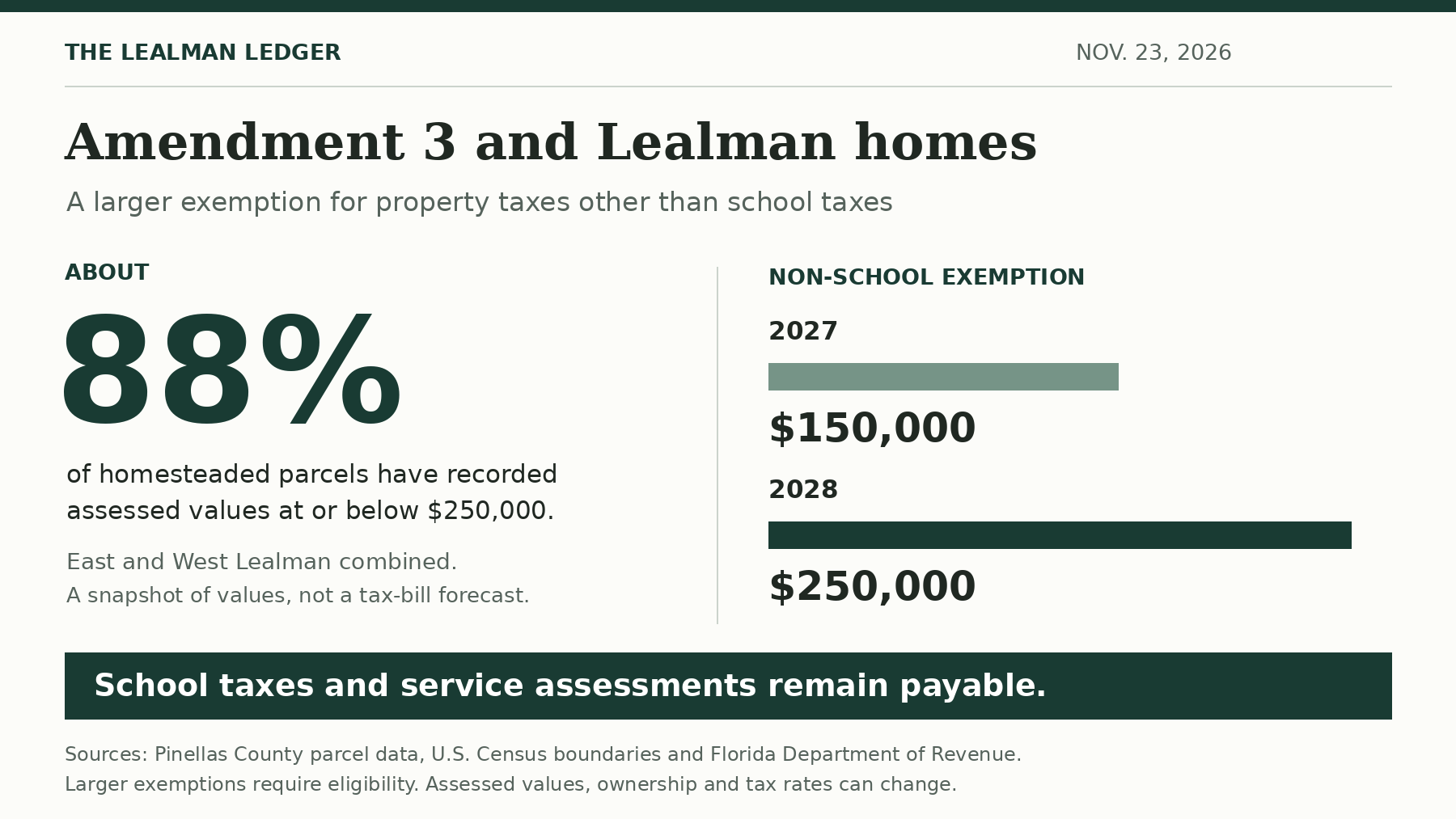
Nearly nine in 10 homesteaded properties in East and West Lealman have recorded assessed values low enough to fit inside Amendment 3’s $250,000 non-school tax exemption scheduled for 2028, a Ledger review of county parcel data found.
For eligible homeowners whose entire property qualifies, that could eliminate the county, fire district and other non-school property taxes on their homes. School taxes would remain, along with any service assessments that appear separately on the bill.
The amendment, approved by Florida voters Nov. 3, raises the non-school homestead exemption to $150,000 in 2027 and $250,000 in 2028, according to the Florida Department of Revenue. Inflation adjustments begin in 2029. The larger exemption replaces the existing non-school homestead exemption.
The local figures show why that change reaches so many homes here. Of 8,853 homesteaded parcels with recorded assessed values in the two communities, 7,800, or 88.1 percent, were assessed at $250,000 or less. About 67 percent were already at or below the first-year ceiling of $150,000.
The 88 percent figure describes the share of properties within that value range. Each household’s percentage savings will depend on its own assessment, exemptions and tax rates.
The review used Pinellas County parcel records and U.S. Census boundaries for Lealman, commonly called East Lealman, and West Lealman. These boundaries cover a different area from the Lealman Community Redevelopment Area.
The dataset was last updated June 8. Those records are a snapshot. They cannot establish what each property will be assessed at in 2028 or whether its owner will still qualify. Partial homesteads require individual review. As a check on rising values, increasing every recorded assessment by 3 percent a year for three years still leaves about 85 percent at or below $250,000. That calculation assumes the same properties and owners.
The median recorded assessment was $105,855. Assessed value is the number used before exemptions are subtracted to calculate taxable value. It can be far below a home’s selling price, especially when the owner has held the property for years under Florida’s Save Our Homes assessment limit.
A home assessed at $106,000 shows the scale of the possible savings. Using the 2025 rates for Lealman’s LETF taxing area and the 2026 standard homestead exemption, its annual property taxes would include about $806 in non-school levies and $510 in school taxes.
Under the $150,000 exemption, that same fully qualifying home would owe no non-school property tax if its assessment stayed at $106,000. At the same rates, the savings would be about 61 percent of its property taxes, or $67 a month.
This is an illustration, not a quoted tax bill. It holds tax rates and assessed value steady, uses only the standard homestead exemption and excludes service assessments. Owners with additional exemptions may already owe less.
Homes assessed above $250,000 can also receive a tax cut. The larger exemption reduces the value subject to non-school taxes even when it does not eliminate that value altogether.
Eligibility matters. The Department of Revenue said people who are not Florida residents as of Dec. 31, 2026, receive the smaller exemption when they first qualify for homestead, with access to the increased exemption beginning in their fifth year of exemption.
For existing homesteads, Save Our Homes continues to limit annual assessment increases, generally to the lower of 3 percent or inflation. A sale or other qualifying ownership change can reset an assessment. The amendment’s text preserves the distinction between school taxes and the other property taxes covered by the larger exemption.
The savings also mean less taxable property value supporting county services and the Lealman fire district. How those agencies set future rates and budgets will affect owners who still have taxable value. A higher property tax rate applied to a fully exempt home would still produce no non-school property tax, but separate service assessments are outside the homestead exemption.
Homeowners can check the assessed value and homestead status on their Pinellas County Property Appraiser record. The St. Johns County Property Appraiser’s explanation of the statewide change says existing homestead recipients do not need to reapply for the larger exemption. Individual eligibility decisions here belong to the Pinellas County Property Appraiser.
The Ledger’s calculation notes describe the parcel count and the limits of the estimates. The 2026 tax bills are unchanged by Amendment 3. The first bills reflecting its new exemptions will be mailed in November 2027.