
Lealman Crime, By the Numbers: Part 3
Controlled-substance possession charges rose in the sheriff's Lealman study area even as the overall count of selected charges fell. The increase puts a different question before residents: does it reflect more drug activity, more enforcement, or both?
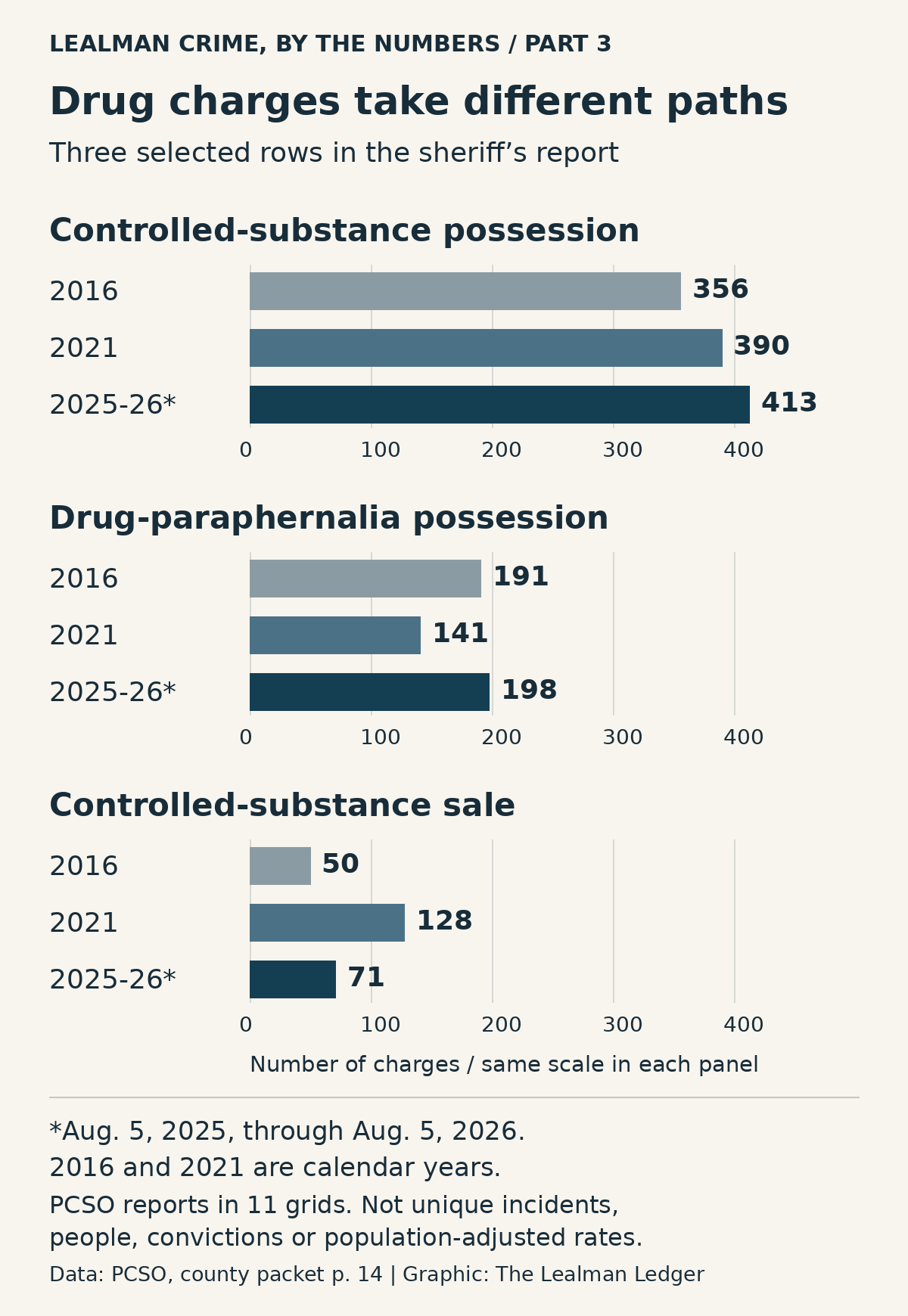
The possession row in documents provided by the Pinellas County Sheriff climbs from 356 charges in calendar 2016 to 390 in calendar 2021 and 413 from Aug. 5, 2025, through Aug. 5, 2026. The latest count is 57 higher than in 2016, about 16%, and 23 higher than in 2021, about 6%.
Those are recorded charges, not a count of people using drugs. The report does not establish why they increased.
Drug-paraphernalia possession follows a different path: 191 charges in 2016, 141 in 2021 and 198 in the latest period. That is a rise of 57 charges, about 40%, after the 2021 snapshot. Compared with 2016, however, the increase is just seven charges, about 4%. The choice of starting point changes the impression considerably.
Sales charges complicate the picture further. The controlled-substance sale row rises from 50 in 2016 to 128 in 2021, then falls to 71 in the latest period. Its roughly 45% decline after 2021 still leaves it 42% above the 2016 count. Possession with intent to sell or distribute falls from 20 to 23 to six. Trafficking charges rise from 13 to 22 to 25.
These are separate rows, and the chart shows three of them rather than a combined drug-crime total. Other drug classifications appear elsewhere in the table. The report does not identify which substances account for the broad controlled-substance possession row, so it cannot establish a Lealman fentanyl or methamphetamine trend.
The changing balance within the table is striking. Controlled-substance possession accounts for about 14% of all selected charges in 2016 and 27% in the latest period. Possession counts rose while the table's overall total fell from 2,583 to 1,523. That larger share describes the composition of the sheriff's selected records. It does not mean 27% of Lealman's residents use drugs, or that this category represents 27% of all crime.
As Part 1 explained, the Pinellas County Sheriff's Office counted charges attached to its own offense reports in 11 geographic grids. Reports generated by other agencies were excluded, and one report can contribute multiple applicable charges. The figures are not unique incidents, people, convictions or population-adjusted rates. The latest window crosses two calendar years; the earlier columns cover calendar 2016 and 2021.
Drug charges also depend on what officers encounter and record. A rise could reflect changes in drug activity, deployment, investigations, reporting or charge classifications. These tables do not separate those possibilities. Neither a higher possession count nor a lower sale count, standing alone, measures whether residents are experiencing less drug-related harm.
Independent research shows why enforcement and harm need separate measures. A 2022 analysis by The Pew Charitable Trusts found that national drug-possession arrests barely changed from 2009 to 2019 while arrests for sales and manufacturing fell by roughly a third. That historical national research examines arrests, not Lealman's selected charges. It provides context, not a local benchmark or an explanation for these results.
For Sheriff Bob Gualtieri's office, useful follow-up evidence would include the substances involved, annual counts of unique incidents and people, and changes in patrol assignments or drug operations. Overdose and emergency-response figures for the same area and dates could add a separate measure of harm. Countywide totals would need to remain clearly labeled as countywide.
The packet supplies none of those comparisons. It also provides no analysis linking these drug-charge changes to Flock cameras. The numbers support a finding of rising recorded possession charges, but not a conclusion about which enforcement strategy worked.
Gualtieri is scheduled to present at the Lealman Community Redevelopment Area Advisory Committee's Oct. 28 meeting at 6 p.m. at Lealman Exchange, 5175 45th St. N., Building A. The agenda includes citizen input and says the presentation will conclude with questions and discussion with the committee. Explaining what sits behind the rising possession count would give residents more than another set of bars.
Previously: Part 2 examined burglary and vehicle-theft charges.