
Lealman Crime, By the Numbers: Part 5
The stretch of 34th Street North near 50th Avenue North remains a prominent crime hot spot in the sheriff's two most recent Lealman analyses. The concentration persists in the maps even as the report's separate table shows fewer selected charges across the wider study area.
In documents provided by the Pinellas County Sheriff, the 2021 analysis identifies a compact concentration along the corridor between approximately 48th and 52nd avenues north. The latest analysis, covering Aug. 5, 2025, through Aug. 5, 2026, again highlights the general lodging and commercial area near 50th Avenue.
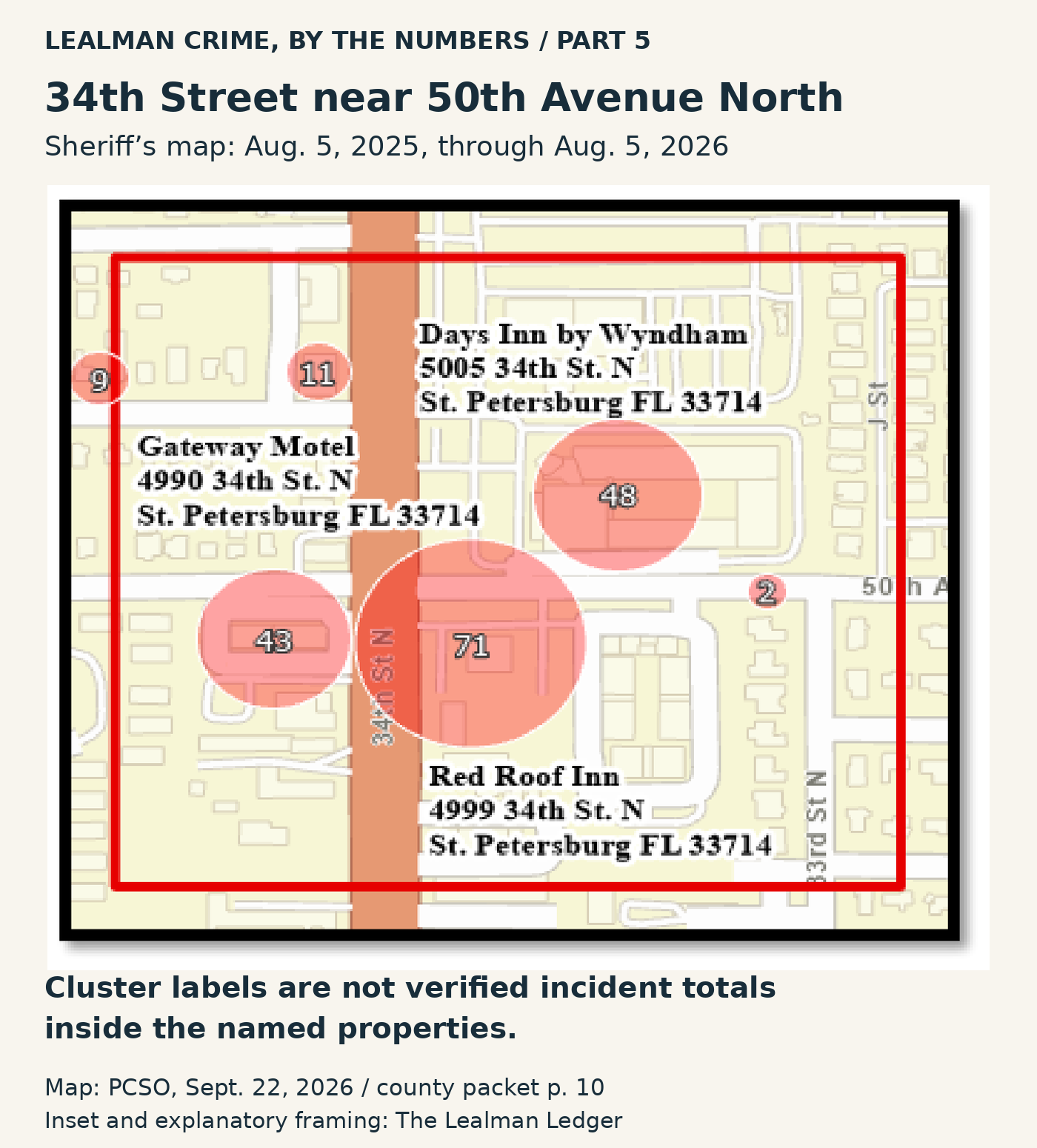
The office uses Gateway Motel, Red Roof Inn and Days Inn by Wyndham as nearby landmarks in both descriptions. Those labels help readers locate the clusters. They do not establish that every mapped offense happened inside those properties or that a business, its guests or its employees caused the concentration.
The latest map's accompanying text describes an aggregated cluster of approximately 71 incidents near Red Roof Inn, another of approximately 48 near Days Inn by Wyndham, and one of approximately 43 near Gateway Motel. The office's 2021 narrative gives approximately 87, 54 and 35, respectively, near the same landmarks.
These are the sheriff's descriptions of mapped clusters, not independently verified property totals. The close-up maps use different framing and highlighted extents. The packet does not provide the underlying incident list or enough detail to establish that each cluster was assembled on an identical geographic basis. Subtracting the labels to calculate a precise improvement or deterioration for each motel would go beyond that evidence.
The recurring corridor is the more firmly supported finding. The office's comparative analysis says the same general area remained prominent in the two later snapshots, although the size and distribution of individual concentrations changed.
The 2016 pattern was different. The sheriff's narrative identifies concentrations near 54th Avenue North and around Florida Sands Mobile Home Park and Grove Park Avenue North. It describes activity spread among several nearby commercial, lodging and residential areas. Those earlier locations should not be treated as proof that crime moved from a specific property to the 34th Street corridor; three snapshots do not track the same incidents or people over time.
Nor does a persistent hot spot contradict an overall decline. A location can remain relatively concentrated while recorded activity falls across a larger area. As Part 1 explained, the separate selected-charge table falls from 2,583 in 2016 to 2,115 in 2021 and 1,523 in the latest period. That table counts charges attached to PCSO-generated reports in 11 grids, with multiple applicable charges possible in one report. It does not count unique crimes, victims or a population-adjusted crime rate.
The map pages label their data source as an incident/offense report summary covering all charges and describe clusters as incidents. The packet does not demonstrate that those cluster labels can be added together or reconciled directly to the selected-charge totals. The Ledger has kept the two measures separate.
The heat-map legend also runs from sparse to dense without numerical thresholds. A darker or brighter patch alone cannot establish the amount of change between years without knowing whether the mapping settings and scales stayed consistent.
Independent guidance supports asking what is inside a hot spot before choosing a response. A 2019 guide sponsored by the Bureau of Justice Assistance calls for detailed examination of police incidents and other information to understand why activity clusters, then tailoring the response to the contributing conditions. That guidance does not diagnose this Lealman corridor.
For Sheriff Bob Gualtieri's office, the practical questions are which offenses dominate this area, when they occur, how many involve repeat locations or victims, and what actions were taken between the two recent snapshots. The maps identify a place to examine. They do not establish the effectiveness of patrol changes, redevelopment efforts or Flock cameras.
Gualtieri is scheduled to present at the Lealman Community Redevelopment Area Advisory Committee's Oct. 28 meeting at 6 p.m. at Lealman Exchange, 5175 45th St. N., Building A. The agenda includes citizen input and questions and discussion with the committee after the presentation. Residents have a specific place to ask about: the corridor the sheriff's own analysis identifies twice.
Previously: Part 4 examined domestic-related charge trends and their limits.