
Lealman Crime, By the Numbers: Part 6
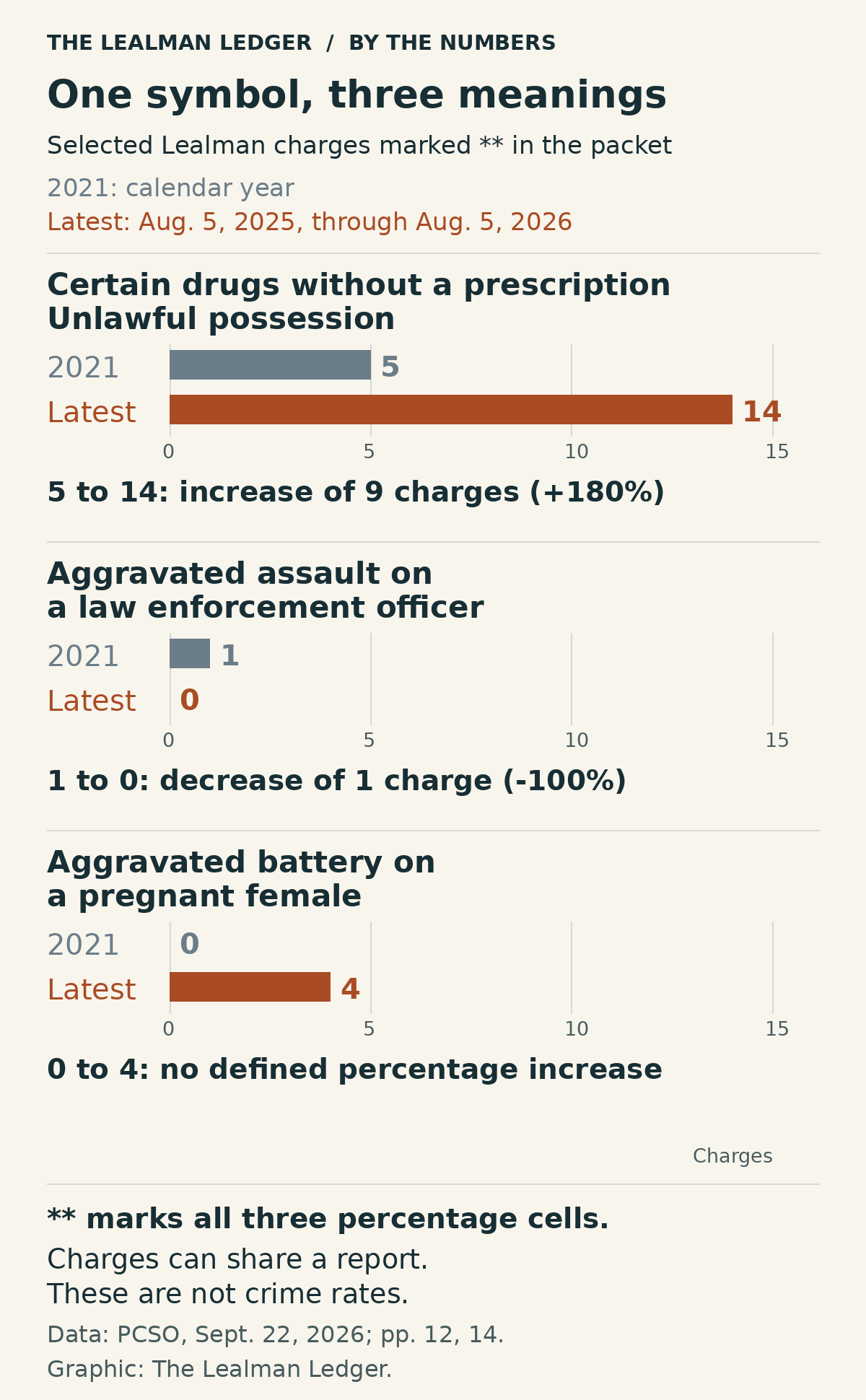
A pair of asterisks in the sheriff's Lealman crime table can stand for very different changes: a rise from five charges to 14, a fall from one to zero, or a new count where the earlier period recorded none. Reading only the printed percentages would miss all three.
The footnote in documents provided by the Pinellas County Sheriff explains the rule. Percentage changes are withheld when the starting count is zero or the change is at least 100% in magnitude. The counts remain visible. The notation is a display choice, not a finding that nothing changed or that a change lacks statistical significance.
That distinction matters ahead of Sheriff Bob Gualtieri's presentation to the Lealman Community Redevelopment Area Advisory Committee. The table documents a substantial decline in selected charges. Its footnotes and category labels determine what residents can reasonably conclude from it.
Consider the row for unlawful possession of certain drugs without a prescription. It records five charges in calendar 2021 and 14 during Aug. 5, 2025, through Aug. 5, 2026. The increase is nine charges, or 180%, calculated by dividing nine by the starting count of five. The table prints two asterisks instead of that percentage.
On the first page of the charge table, aggravated assault on a law enforcement officer goes from one charge to zero over the same comparison. That is a decrease of one, or 100%, and it receives the same notation.
The aggravated-battery-on-a-pregnant-female row moves from zero to four. Its increase can be stated as four charges, but a percentage increase cannot be calculated by dividing by a zero starting count. It, too, gets asterisks. The graphic shows these three rows separately, using the same count scale.
There is a further convention worth clarifying: the table prints 0% for some zero-to-zero comparisons, including that pregnant-female row between 2016 and 2021, despite the footnote's general wording about zero baselines. The underlying counts are unchanged in those cells; the displayed percentage is not the result of the usual percentage-change calculation.
None of these examples establishes a broad change in neighborhood risk. Small starting counts can produce large percentages, and a zero in one selected charge category does not establish that every related form of harm disappeared. Readers need the count, the category and the reporting window together.
The table's overall decline remains clear: 2,583 selected charges in calendar 2016, 2,115 in calendar 2021 and 1,523 in the latest window. The latest total is 1,060 lower than the first, about 41%. But a total of charges is not a total of unique crimes, victims or convictions.
The Sheriff's Office says it queried 11 county grids and excluded reports generated by other agencies. A single PCSO offense report can contribute more than one applicable charge. The packet does not provide the count of distinct reports behind each total, so readers cannot tell whether charges per report changed. Nor does it provide population figures matched to those grids for calculating a rate.
The three snapshots also leave the timing unresolved. Annual counts between 2016 and the latest period would show whether declines were steady, concentrated in a few years or interrupted by increases. Counts for consistent calendar years, or matching August-to-August windows, would make the time comparisons easier to assess.
Independent guidance reinforces the need for more than a single measure. The FBI's guidance on the proper use of crime statistics identifies enforcement priorities, agency resources and residents' reporting practices among the factors that matter when assessing police performance. That guidance concerns the national Uniform Crime Reporting program, not this local charge table; it does not explain why Lealman's numbers changed.
For this report, a useful follow-up would supply annual counts of unique reports alongside charges, definitions and coding histories for the selected categories, and a map of the study grids with any boundary changes identified. Explaining how corrected or duplicate reports were handled would also help readers reproduce the totals. These are unanswered questions, not evidence that the office counted incorrectly.
Any claim that Flock cameras or another intervention caused the decline would need a separate evaluation tied to when and where the intervention operated. The packet's three charge totals cannot establish that connection.
The county currently lists the committee's Oct. 28 meeting for 6 p.m. at Lealman Exchange, 5175 45th St. N., Building A. The agenda includes citizen input and says Gualtieri's presentation will end with questions and discussion with the committee. A practical starting point is to ask for the underlying counts and definitions that would turn three snapshots into a clearer account of what changed.
Previously: Part 5 examined the recurring 34th Street hot spot. Part 1 introduced the report and its limits.