
Lealman Crime, By the Numbers: Part 8 of 8
The sheriff's Lealman report documents 1,060 fewer selected charges in its latest period than in 2016. It does not tell residents how much public spending contributed to that decline, which intervention worked or what a measurable safety gain cost.
That gap matters because the same Oct. 28 meeting packet places crime figures alongside a redevelopment work plan. The documents show activity and funding, but they do not connect the two through an evaluation of results.
The documents provided by the Pinellas County Sheriff list 2,583 selected charges in calendar 2016, 2,115 in calendar 2021 and 1,523 from Aug. 5, 2025, through Aug. 5, 2026. The first-to-latest decrease is about 41%. Those are charges attached to PCSO-generated offense reports in 11 grids, not unique crimes, victims, convictions or population-adjusted rates. A report can contribute multiple applicable charges.
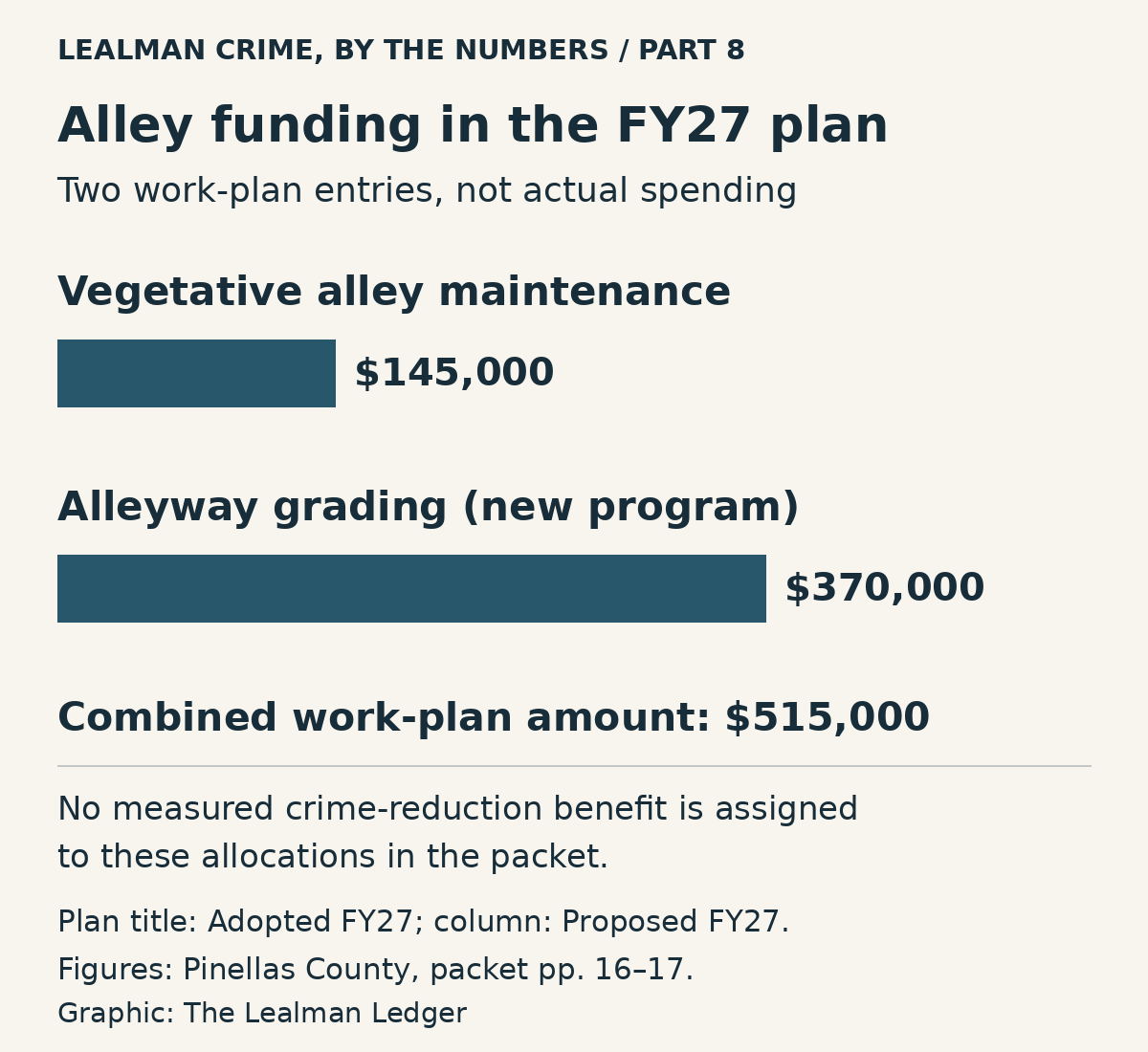
Elsewhere in the packet, the Lealman Community Redevelopment Area work plan lists $145,000 for vegetative alley maintenance in its FY27 column, compared with $140,000 in approved FY26 funds. The description attributes the $5,000 increase to a contract adjustment tied to the Consumer Price Index and describes recurring maintenance and vegetation clearing.
A separate new alleyway grading program carries $370,000 in the FY27 column for contracting to grade alleys used by heavy vehicles. Together, these two entries total $515,000. They are distinct maintenance programs, not a combined police budget or a complete list of neighborhood safety spending.
The document is titled “Adopted FY27 Lealman CRA Workplan,” although its dollar column retains the heading “Proposed FY27.” The chart reproduces those entries as work-plan amounts. Neither the entries nor the chart establishes that the money has been spent. The new FY27 grading allocation also cannot, by itself, explain a crime-reporting window that ended Aug. 5.
There is evidence of a reported maintenance result. The county's FY25 performance measures identify enhanced public safety as an objective of the Alleyway Project. The stated standard is maintaining and clearing an average of two obstructed alleys per month so they are traversable. The county marks that standard achieved.
That is a statement about work performed against a maintenance target. It is not a measurement of crime prevented. The performance sheet does not compare offenses before and after clearance at those alleys, and the sheriff's crime tables do not identify which records came from treated locations. Accessible alleys can have practical value without this packet proving a particular reduction in charges.
The same distinction applies to cameras: finding a stolen vehicle, helping solve a case and preventing a future offense are different outcomes. The Lealman packet supplies no camera deployment timeline, local cost accounting or case-outcome table that would tie Flock use to the reported decline.
Independent research illustrates why outcomes should be separated. A 2021 study summarized by the National Institute of Justice compared patrols with and without vehicle-mounted license plate readers at suburban crime hot spots. Reader use increased stolen-vehicle recoveries but did not increase arrests or reduce the likelihood of a new call while officers were present. It also did not change the timing or seriousness of the next call after patrol.
That study evaluated a particular patrol deployment elsewhere. It does not establish whether Lealman's Flock cameras work, and it is not an evaluation of Flock installations in Lealman. It does show why an agency should state which benefit it is measuring rather than treating every camera-related result as evidence of prevention.
A useful local accounting would pair actual expenditures with dated deployments and defined outcomes. For alley work, that means locations, completion dates, maintenance costs and comparable incident counts. For cameras, it means installation and subscription costs, staff time, documented investigative contributions and case outcomes, with safeguards against counting the same case repeatedly. A claim about prevention would additionally need a credible comparison showing what happened without the intervention.
Dividing a redevelopment allocation by the decline of 1,060 charges would not produce a defensible cost per crime prevented. The money and charge counts cover different periods and purposes, charges are not unique crimes, and the packet has not established causation.
Sheriff Bob Gualtieri is scheduled to present at the committee's Oct. 28 meeting at 6 p.m. at Lealman Exchange, 5175 45th St. N., Building A. The agenda includes citizen input and questions and discussion with the committee after his presentation. The packet says a work-plan update will follow if time allows.
The decline in recorded charges is worth documenting. The next accountability test is whether officials can identify the actions behind it, the costs actually incurred and the evidence that distinguishes a completed task from a safer neighborhood.
The complete series: Part 1 · Part 2 · Part 3 · Part 4 · Part 5 · Part 6 · Part 7 · Part 8